
Westmont Neighbor Lookup Sources
Official records describe land, taxes, registration, public service, and historical entries. They do not merge into a complete list of Westmont neighbors.
| Source | What It Shows About a Block | Access |
|---|---|---|
| DuPage GIS Parcel Viewer | Parcel shapes, nearby lots, layers, selected results | Free official viewer |
| DuPage property cards | PIN, situs, owner or billing display, tax year | Free public portal |
| DuPage voter search | Registration and district information under election rules | Identity fields and purpose limits apply |
| Village community links | Library, Park District, Chamber, service and civic groups | Public organization pages |
| 1920s directories | Dated names, spouses, phones, streets and intersections | Illinois Digital Archives |
A tax-card name identifies the party displayed for a parcel and year. It does not prove that person lives there. A directory or voter result has a different date and rule. Match at least two facts before connecting a name to a block.
Buffer a Westmont Block
The DuPage GIS help documents an edge buffer with 250 feet as its default distance. A user can choose the source selection, set feet as the unit, run the buffer, and inspect the selected parcels in the results tab. Because distance runs from the parcel edge, the shape is more useful than drawing a rough circle around a street point.
- Search the starting address or dash-free PIN.
- Open the correct parcel popup and confirm its situs.
- Choose the proper selection source and set the buffer distance.
- Run the tool and inspect each selected PIN in the results tab.
- Open tax cards separately and label all names as owner or billing parties.
Export the selected results with the map date and settings. A buffer is a reproducible geographic query, not a statement about personal relationships.
Westmont Neighbor Map Layers
Roads, streams, wetlands, floodplain, parcel boundaries, and historic aerial imagery can explain why nearby lots do not form a simple row. Layer visibility varies with map scale. Shapes and selected results can also be printed to PDF, but the viewer's disclaimers still apply.
A stream, private street, park, or municipal edge may make two close parcels part of different service settings. Use the physical layers for context, then use the property card for tax data. Neither source reveals private household details.
Map Westmont Neighbor Parcels
A parcel workflow keeps the immediate block distinct from the full street. Begin with one verified land unit, then move outward through selected GIS results.
- Locate the address in DuPage GIS and verify the PIN and situs.
- Select surrounding parcels or use the edge buffer.
- Open each current property card and note its tax year, owner or billing name, and mailing display.
- Keep every party labeled by source. Do not convert a mailing match into proof of occupancy.
The Westmont street directory carries the work beyond the immediate block into deeds, permits, ZIP labels, and historical street forms.
Westmont Community Directory Layer
No complete official neighborhood-association roster was located. The Village instead points to umbrella and civic organizations that publish current contacts, meeting notices, or public leadership names. These sources help a newcomer find the right community channel without pretending to list all neighbors.
| Organization | Public context | Use |
|---|---|---|
| Westmont Public Library | Library services and local research | History help and public programs |
| Westmont Park District | Recreation and facilities | Community events and contacts |
| Westmont Chamber | Local business network | Public member and event information |
| Westmont Special Events Corporation | Village event partner | Public programs and civic context |
| Lions, Rotary, Knights of Columbus | Named Village service clubs | Official club contacts and notices |
Boards and Commissions adds Village Board, committee, and citizen-application material. These are civic sources, not household directories.
The Village community organizations page shows the official link collection.
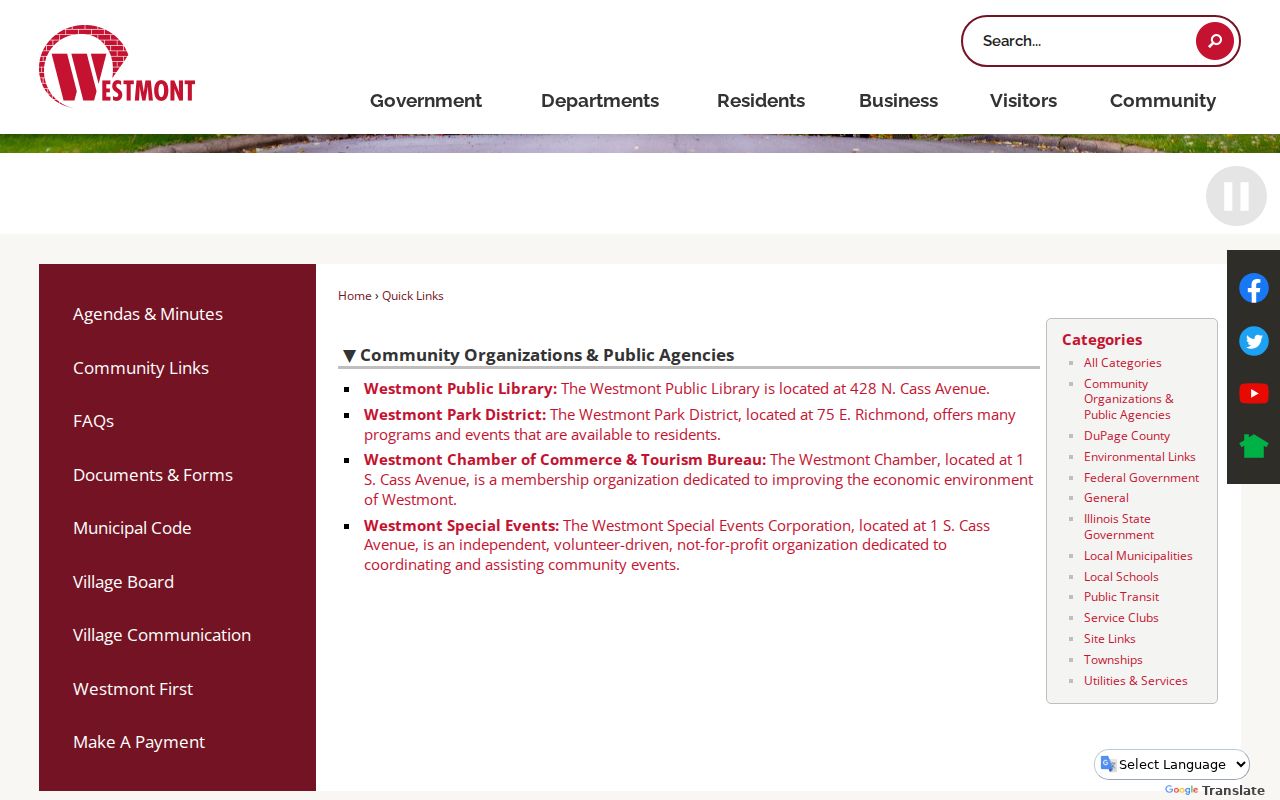
The screenshot is a route to current organizations. Date any officer or contact name found after following it.
Westmont Neighbors Across Boundaries
The 2023 Village map shows six ZIP areas touching Westmont and labels Clarendon Hills, Downers Grove, Oak Brook, Willowbrook, and unincorporated DuPage around the boundary. It also depicts private streets, parks, boundary agreements, and roads that are not through streets. Postal proximity is not the same as sharing a municipality.
Cass Avenue helps explain a utility split, while the Village notes that School District 201 serves the majority north of 55th Street. Property cards may list sanitary, township, fire, library, school, and park bodies. Two Westmont neighbors can therefore share a street but not every district. Record the exact parcel and map layer before drawing a boundary conclusion.
Address Concerns Are Not Directories
Westmont's Report a Concern route is address-keyed. It supports anonymous reporting in some circumstances and an account for tracking, while permits, inspections, and code matters have separate Village routes. These tools document service requests or official work. They do not create a public list of people on a block.
The official Westmont concern page shows the municipal reporting options.
For historical status or records not displayed, send a focused FOIA request to the proper Village custodian with an address, date range, and record type.
Official Westmont Neighbor Records
Official county and Village sources identify the custodian, record date, and limits. Commercial neighbor tools may combine old public data without showing when a field changed. They can also confuse a tax owner, former address, or postal label with a current resident.
Official rolls
Best for a dated PIN, mapped parcel, deed party, district, or public civic role. The source office can explain access and corrections.
Commercial category
May be fast, but provenance, update timing, and lawful reuse can be unclear. Verify every useful lead at its official source.
For block research, source quality matters more than the number of names returned.
Historic Westmont Neighbor Blocks
The 1925-26 and 1927-28 directories preserve a block-level view from the years just after incorporation. Entries can include a surname, given name, spouse, street or intersection, telephone, historical descriptor, and civic title. Read adjacent entries on the page, since a street section can reveal nearby names that a surname index alone misses.
Historical wording needs its own checks. Westmont developed around a railroad station, and Gregg's Station can appear as useful early search language. The Village says early plats were laid out in the early 1900s and the streets are basically unchanged, but an old cross street must still be checked against a plat, newspaper, deed, or map. No verified Westmont street-renumbering year was found.
Compare only sources close in time. A 1920s directory name, a 1935 Sanborn sheet, a later newspaper notice, and a modern PIN describe different moments. Preserve the page or map citation and avoid implying continuous residence. Historical neighbors are best understood as a dated block snapshot, not a current contact list.
Westmont Neighbor Privacy Limits
Illinois has no single opt-out from every public record. Each custodian follows the rule for its record. The Address Confidentiality Program gives qualifying survivors a substitute address and warns that it does not ensure property-record confidentiality. Never use that warning as a reason to seek a participant's physical location.
Property records do not guarantee occupancy. Voter data is purpose-limited, and court or agency sources may suppress protected fields. Public forms can collect sensitive details to establish identity or eligibility without making those fields public. Show only the minimum needed to explain a result, omit full birth dates and identifiers, and report a no-result as a source result rather than a fact about a person.
Lawful use. Use Westmont neighbor records for civic context, reconnection, or personal safety. Never use them to watch, harass, intimidate, or expose anyone.