
Westmont Resident Lookup Sources
No official database is a complete list of Westmont residents. Each source proves a limited fact at a stated time. The DuPage property card concerns a parcel and its owner or billing name, not every occupant. Election lookup confirms a registration only after the user supplies identifying details. Court entries concern a case. Vital-record custodians test eligibility before releasing a certificate. A careful resident lookup treats these limits as part of the answer.
| Record | What It Confirms | Where to Search | Access |
|---|---|---|---|
| Property card | Recorded owner, billing name, situs address, PIN | DuPage County Property Records Search | Public web search |
| Voter lookup | Individual registration and election details | DuPage Election Division | Identifying fields required |
| Court docket | Case status, next date, docket entries | DuPage Circuit Clerk | Public application or clerk copy |
| Vital record | A qualifying birth, death, marriage, or dissolution event | DuPage custodian or IDPH | Eligibility and fees apply |
| License or entity filing | Professional credential or public business role | IDFPR or Illinois SOS | Public verification |
Choose the first source from the fact already known. An address points to the county property search. A case type or court date points to the Circuit Clerk. A profession may justify checking IDFPR, while a business connection belongs in the Secretary of State entity search. When only a name is known, add a year, city, or middle initial before accepting a result. This keeps one Westmont resident from being confused with another person elsewhere in DuPage County.
The remaining channels matter when a web portal is down or incomplete. The Recorder offers online indexed documents and images beginning March 16, 1961, but its search-key coverage differs: name searches reach 1961, PIN searches 1985, and address searches 1995. In-person property research reaches 1839. The Circuit Clerk accepts copy orders online, by mail, and at the Wheaton courthouse. Village material that does not have a public index may be requested from Westmont under FOIA. Library databases, digitized newspapers, and staff research help add historical context without turning an old mention into a claim about current residence.
Checking Westmont Court Records
Westmont state cases are kept by the DuPage County Circuit Clerk public application. Its landing page promises case status, the next court date, and docket entries. A docket is the dated list of filings and events in a case. The inspection used for this project reached a Turnstile challenge, so the exact name-search controls and a live sample result could not be confirmed. Do not fill that gap with guessed fields.
| Portal item | What was verified |
|---|---|
| Search for your Case | Official public-case entry point |
| Case status | Promised on a successful search |
| Next court date | Promised on a successful search |
| Docket entries | Promised, but no sample docket was opened |
| Traffic updates | Optional email registration is described |
If the challenge blocks access, call the civil desk at 630-407-8700 or the criminal and traffic desk at 630-407-8600. Public copies can be ordered through the Clerk's I2File route, by mail, or in person at 505 N County Farm Road in Wheaton. eAccess-CRIS is a separate account system and excludes inactive, impounded, sealed, expunged, and certain juvenile matters.
Copy costs also differ from simple online viewing. The Clerk lists $2 for the first page, 50 cents for pages 2 through 20, 25 cents for each page after 20, and $6 for certification. Confirm that the file is public before paying. A case result can establish that a named party appears in a dated proceeding, but it cannot establish a home address or tell the full story of the dispute. Read the case number, court type, status, and docket dates together. Federal matters are separate and belong in PACER for the Northern District of Illinois, not the DuPage state-court search.
The official court screen captured for this resident lookup is shown after the Circuit Clerk search entry point is opened.
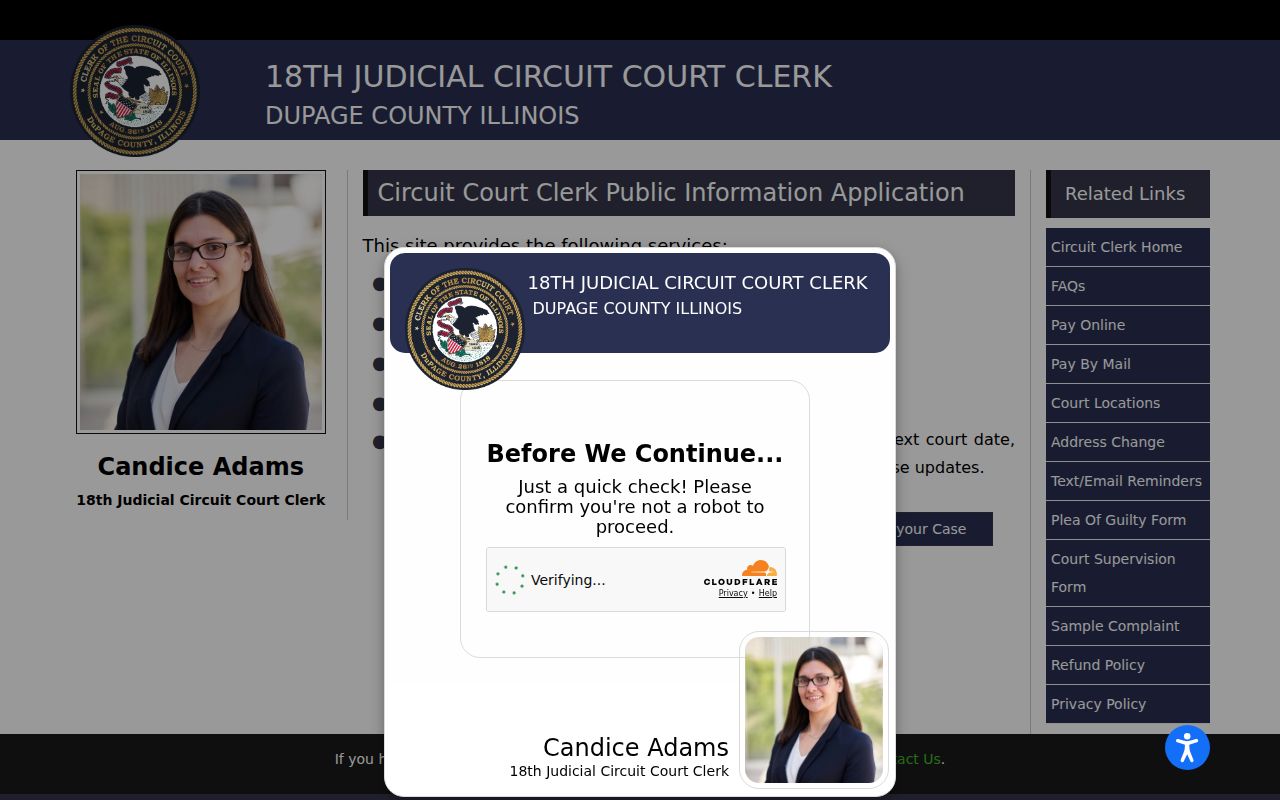
The image confirms the public route and its stated result categories, but it does not prove a match to any named resident.
Separate Same-Name Westmont Residents
A shared name is the main trap in a resident lookup. Compare non-sensitive facts instead of forcing a match: middle initials, approximate year, case type, parcel location, agency, or professional field. The Property Records Search accepts an owner or billing name as well as a PIN and address. A property result still identifies an owner or billing party, not everyone who lives there.
Record the date and source of each finding. If two sources conflict, the office that keeps the record is the place to correct it. A deed index may use an older surname, a directory may preserve an abbreviation, and a court case may name a different person with the same spelling. Certainty comes from agreement among distinct records, not the number of search results.
Business and professional records need the same restraint. The Illinois Secretary of State entity search may display an entity name, file number, status, registered agent, officers or managers, and filing facts. That role does not prove that an officer lives at a registered office. IDFPR describes its license checker as the state-maintained primary verification source, with single-record data updated daily and a possible delay after issuance. Record the license type, status, agency, and lookup date. A credential is evidence about a state authorization, not a private address. Westmont business registrations are handled through the Village Clerk and Community Development, but the research found no open historical registration table.
Westmont Voter Lookup Fields
The DuPage Election Division voter search is designed to find an individual registration after the user supplies identifying details. The visible controls include name, date of birth, the last four digits of a Social Security number or a driver's-license number, address and district filters, and an information-type choice. Those inputs are safeguards and search keys, not facts to republish.
Illinois voter files are not a bulk people directory. State law limits computerized voter data to defined public and political purposes and bars commercial solicitation or business use under 10 ILCS 5. If the county search fails, the Illinois State Board of Elections offers its own registration lookup. A no-result may reflect a spelling, identifier, jurisdiction, or current registration issue, so contact the Election Division rather than drawing a broad conclusion.
The county address-based election tool separates house number, street name, direction, suffix, and city. Enter those parts as the form expects instead of pasting one long address. District filters can help test a result, but municipal, election, school, and postal boundaries are not the same. Westmont lies within DuPage County, while nearby postal labels and special-district lines can make an address look inconsistent. Treat the official address result as election context. Do not copy sensitive identifiers used to authenticate the search, and do not claim that registration proves day-to-day occupancy.
Confirming Westmont Vital Events
Illinois vital records follow the event location, not a person's current home. DuPage County Health handles local birth and death events from 1953 forward, while the County Clerk supplies DuPage marriage copies. Divorce copies come from the Circuit Clerk where the dissolution was granted. IDPH in Springfield issues state certificates and verifications, but does not issue certified marriage or dissolution copies.
Modern birth and death certificates are not public resident-lookup results. Birth copies are limited to the person, parents, legal guardians, legal representatives, or an authorized court or agency. A death requester must show a personal or property right interest unless an exception applies. IDPH offers genealogy routes for births at least 75 years old and deaths more than 20 years old, not before 1916. Those request windows do not mean every image is online.
For a DuPage event, start locally when the county holds the record. DuPage County Health lists online, mail, and in-person routes for local birth and death certificates. The County Clerk handles a marriage that occurred in DuPage, regardless of where either spouse later lived. IDPH routes certified dissolution copies back to the Circuit Clerk in the county where the judgment was entered. Illinois law also describes separate archival thresholds under 410 ILCS 535/24: 100 years for birth records, 50 for death records, and 75 for marriage records. Those archival rules and IDPH genealogy-copy rules serve different purposes, so cite the exact route used.
Verify Westmont Resident Records
Use a short, repeatable process to verify one person. Start with a source that matches the known fact, then test the candidate against a second official index. Never treat an address, business role, or court party name as proof of current residence by itself.
- Search the known address or owner name in the DuPage property roll and save the PIN, tax year, situs address, and owner or billing display.
- Check the official court or voter route with the full name and permitted identifiers. Try documented spelling variants.
- Compare only non-sensitive context, such as county, year, profession, party names, or case type. Reject a match when key facts disagree.
- Order a certified copy from the correct custodian only when the official document is needed and access rules permit it.
- Docket
- The court's dated list of filings, hearings, orders, and other case events.
- Index vs image
- An index is a finding list. An image is the scanned document, which may have a fee or access limit.
- Certified copy
- An official copy bearing the custodian's certification, used when an ordinary printout is not enough.
Westmont Newspapers Add Context
The Westmont Public Library is a useful fallback when a current portal is too narrow. Ancestry is available only inside the library, while Fold3 and Book a Librarian provide other family-history routes. Digitized Westmont newspapers reach back to the 1940s and include Progress, Challenger, Towne Times, and broader DuPage titles. Obituaries, civic notices, school news, and business advertisements can separate people who share a name.
Newspaper OCR can miss a surname or blend columns. Search variants, then inspect the page image and date. A newspaper mention is a historical clue, not proof that the subject still lives in Westmont. For older directory volumes and how to read them, use the Westmont city directory collections rather than rebuilding that shelf in a one-person search.
Two digitized DuPage directory runs are especially useful for a historical Westmont resident lookup. The 1925-26 McDonough volume and the 1927-28 Smith Directory volume may expose a spouse, street or intersection, telephone, civic title, or business description. Verify an OCR hit against the scanned page. Then test the name and address in a local newspaper near the same date. Westmont Public Library also offers local-history research help through its Adult Desk. These sources can distinguish a relative, classmate, public official, or former business owner while preserving the date of each observation.
I-CASH Finds Name Leads
The Illinois Treasurer's I-CASH search accepts a last name or business name and can narrow by city, ZIP code, or property ID. It is a free official search for unclaimed property. A result can provide a dated Illinois connection, but it does not establish a current home or give a claimant the funds without proof of identity and relationship.
The official name-search screen appears below.
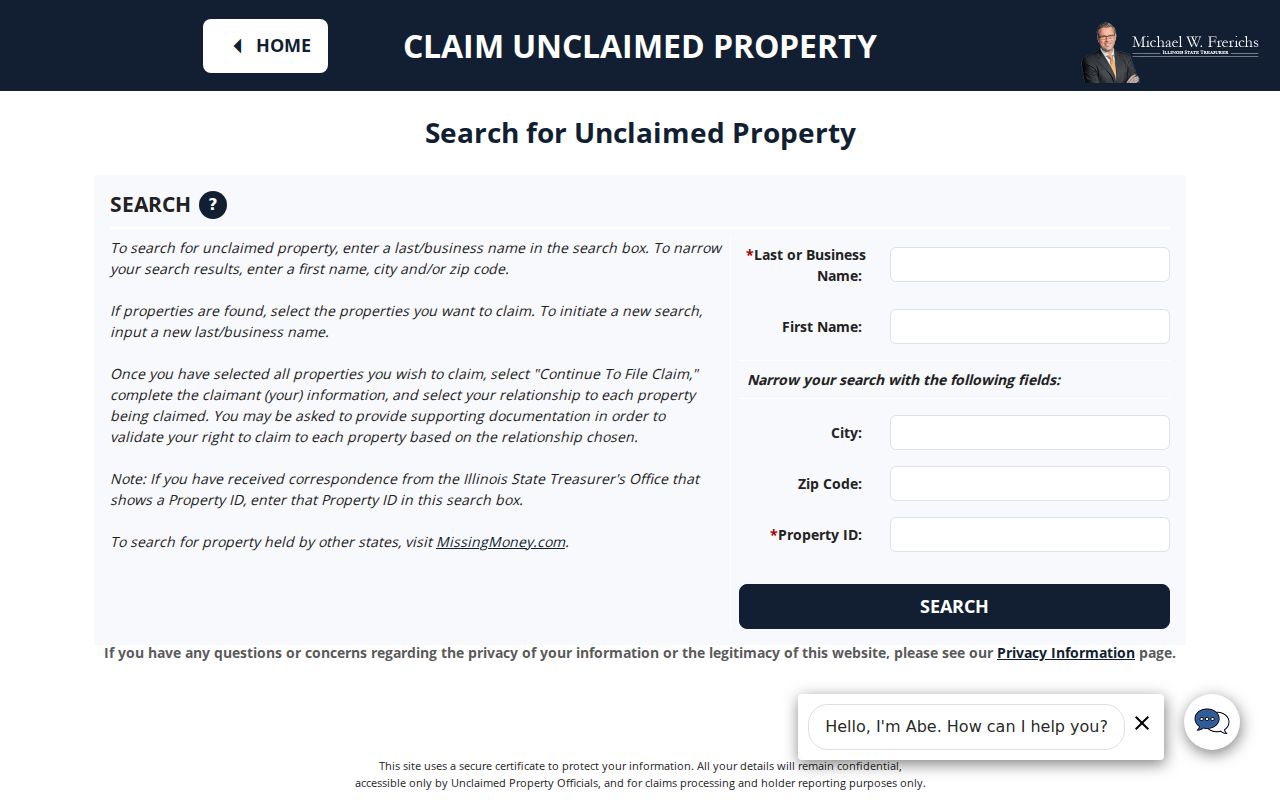
The city and ZIP filters help distinguish a Westmont lead, while the claim process keeps identity documents outside the public result.
Request Westmont Records by FOIA
When no public index exists, send a narrow request to the office that actually keeps the record. Westmont Clerk files, permits, code records, police reports, and 311 submissions belong with the Village. County court, deed, election, and property records stay with their DuPage custodians. Illinois FOIA, 5 ILCS 140, generally gives a public body five working days for a noncommercial request, subject to statutory extensions and exemptions.
Name the record type, date range, location or case number, preferred format, and whether inspection or copies are wanted. Ask for the smallest useful set. FOIA does not open sealed court cases, confidential vital certificates, private identifiers, or records whose release would be a clearly unwarranted invasion of personal privacy. A denial should cite its exemption, and the Illinois Attorney General's Public Access Counselor is the administrative review route.
The response clock begins the day after receipt, and weekends and legal holidays do not count as working days. An agency may invoke a statutory extension when records sit in different places, a request is extensive, or another public body must be consulted. Redaction is preferred when part of a responsive document is public and part is exempt. Keep the request tied to a defined municipal record rather than asking the Village to assemble a broad profile of a person. County FOIA cannot produce a Westmont permit or police file, and Village FOIA cannot produce a DuPage court docket.
Westmont Lookup Privacy Limits
Open indexes do not erase privacy rules. Illinois FOIA protects private identifiers and allows withholding when release would be a clearly unwarranted invasion of personal privacy. Sealed, expunged, impounded, juvenile, and other restricted court matters may not appear. Vital certificates have eligibility rules, and public voter tools do not authorize a bulk directory.
The Illinois Attorney General Address Confidentiality Program gives qualified survivors a substitute address and mail forwarding. Its official page warns that participation does not ensure confidentiality in property records. The Judicial Privacy Act separately lets eligible judicial officers suppress specified home and family information. A missing or substitute address may therefore reflect a legal protection, not a faulty search.
Correction paths also depend on the source. Ask the Property Records office about an owner or parcel display, the Election Division about a registration, and the Circuit Clerk about docket access or copies. A library can help identify a scan, but cannot change a historical volume. The keeper may ask for a case number, PIN, document number, event details, identification, or proof of relationship before acting. Supply only what the official process requires. Do not publish a protected address, private identifier, or sealed detail simply because it appeared in an older or cached source.
Lawful use. Use a Westmont resident lookup only for lawful personal research. Never use a record to stalk, harass, intimidate, or harm anyone.